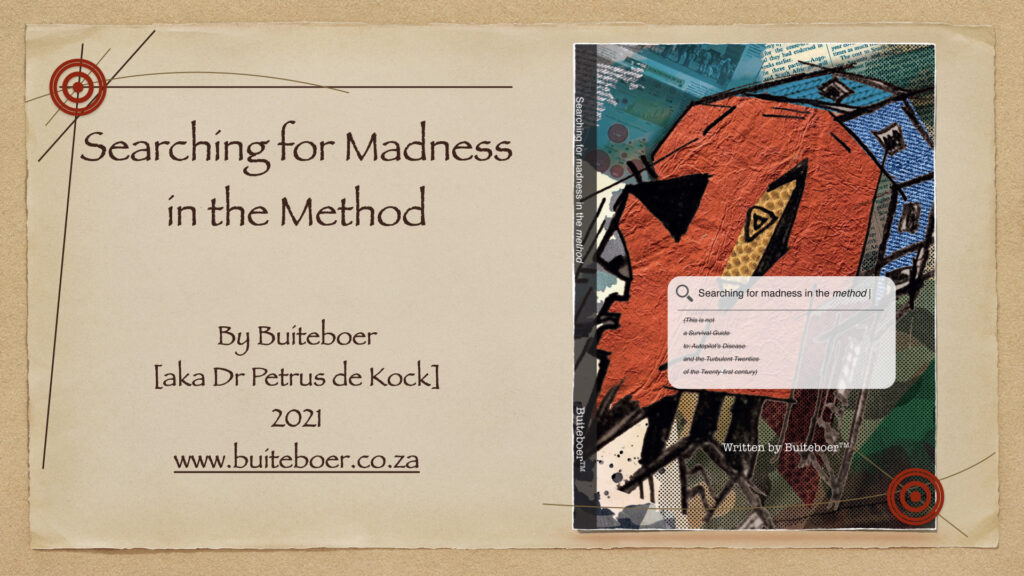
An extract from Buiteboer's book - Searching for Madness in the Method, reflecting on the need to liberate 'the problem' from the grip of Systems of Mind Control
Chapter 14.1 Research and/or/as false Problem
What is a problem then? The word problem, as one of the most over-used words in the English language, itself has a problem. But this problem of the problem is not inherent to itself. The problem lies at the other end of the keyboard: with the ‘User’/formulator/enunciator of ‘the problem’.
In his exploration of the work of Bergson, Gilles Deleuze identifies relevant features of the problem of the problem, which will in this context be applied to a problematisation of research practice(s).
Deleuze contends that societal practices and habits of thought entrench an approach to the ‘problem’ that enslaves both people and their thought. This is because it is expected that a problem is ‘posed’: “Class, I present you with the following problem today.” The task of the person, or student, is then to go about finding a solution/answer to the problem.
In this way humans are kept in mental slavery seeing that, in Deleuze’s words,
“True freedom lies in a power to decide, to constitute problems themselves.”
The posed problem is usually solved by a predetermined set of formulas, methods, calculations, theoretical applications, and prescribed tools.
The true power of the problem can, however, only be unleashed when new and previously unheard of problems are invented. If research is given the power and freedom to invent new problems, then we may find one of the crucial ingredients of another research praxis.
False problems are those pre-made, predetermined one’s the teacher or state presents to people for ‘solving’. The serfs of the Global Digital Feudal age fall over their thumbs to search for answers from GOOGLE, GROK or Claude AI’s and their pre-made answers scavenged from the corpses of books and theses and treatises and pamphlets and posts and whatever their ‘training models’ allowed ‘them’ to vacuum from the public open sources living on the digitospheric ‘web’ [of lies?].
False problems, badly stated problems, and problems that limit freedom to state new or different problems, all combine to shine a spotlight on how research praxis has become nothing but an exercise in reproducing the known (maybe with one or two new ‘insights’ cleverly designed onto a PowerPoint slide).
But, in a war torn pandemic panicked energy starved and food/social-crisis prone world, where known and accepted behaviours, and systems assumed to be part of ‘reality’ are eroded, and collapsing, research cannot revert to pre-made questions and methods to solve problems.
Research runs aground and out of steam because it is not free to invent new problems appropriate to the Turbulent Twenties of the Twenty-First Century.
…
If you found this interesting, it is suggested you look at another extract from Searching for Madness in the Method, which is, Autopilot’s Disease: Credo Mutwa and the Ancient Wonder of the self-driving Hut